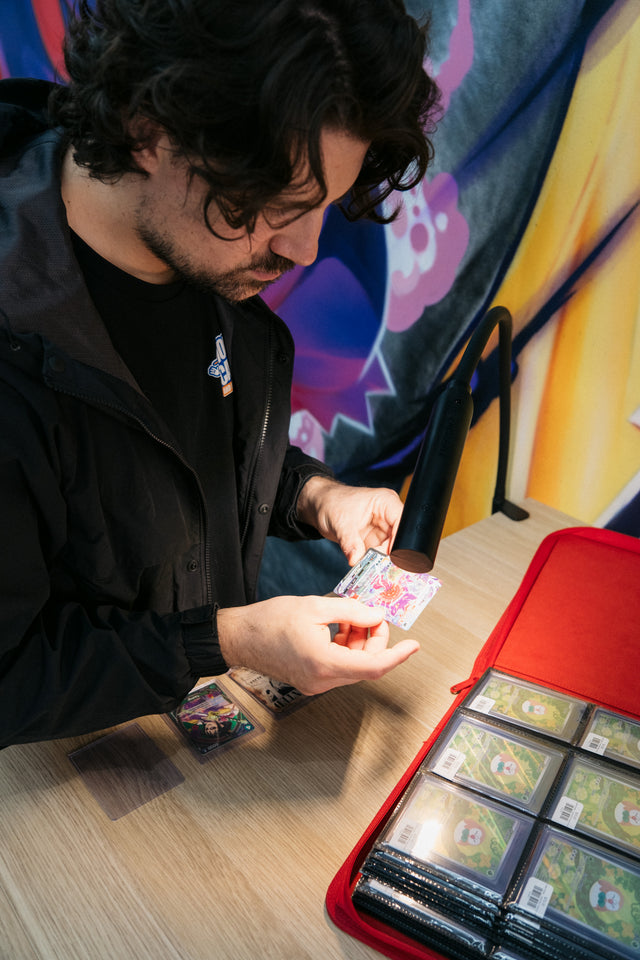
When buying cards for your binder from a TCG shop or Facebook Marketplace, there are a few things we recommend looking out for before buying. Just because it's for your binder, it doesn't mean there aren't a few things you need to watch out for, and our tips will help you get the best card for your binder.
This will not only help with selling your card in future, but you may want to grade it one day.
Top 3 Tips
Card Inspection Basics for Beginners (Quick & Easy Top 3 Tips)
TIP #1 | CENTRING FRONT AND BACK
Flip it over! LOOK AT THE BACK and assess the centring of the card. Without using a ruler, your eyes can judge at this point if it's good enough or way off-centred. Here you are looking at the border around the card. Look at the gap distance on the left and right sides, then the top and bottom. If they look fairly even, that's a very good start! But in most cases, it will likely be uneven. What are you prepared to accept? If you want it for grading one day, this will impact your chances of getting a 10 and can bring it down to an 8 or 9 with PSA. Repeat for the front of the card.
TIP #2 | WHITENING FRONT AND BACK
What this means is you're looking for any white specks around the corners or edges of the card. This is most obvious and usually occurs on the back of the card. Because it's a darkish blue (English Pokémon), it will be very noticeable immediately. It's very common to find this on all cards, from mint fresh out of the pack to heavily played cards, so don't stress. Again, for a binder copy it's perfectly acceptable (the less, the better); however, if grading one day, this will impact your overall grade. So always try to avoid too much whitening.
TIP #3 SURFACE DEFECTS FRONT AND BACK
Here we are looking for things like print lines (which are the most common and often missed by a lot of people, especially newcomers to the hobby). This is a very faint, thin line that runs across the card and can be vertical or horizontal. You’ll probably need a good light to pick this up. Otherwise, you’ll also be looking for dents, scuffs, etc. Again, for a binder copy you may prefer to have one without any dents and scuffs, but they can be easily missed by the naked eye, especially on very graphical cards. Yes, this will impact grading, as companies like PSA, Beckett, and TAG will look for these defects to determine your grade.
This is our very easy top 3 tips to help you identify a good copy for your binder. You don't need anything special here—some good lighting will help with surface defects, but other than that, we hope this helps you on your journey.